

Loft aerial installations
Subject list :
Loft aerial basics
Attenuation through roofs (incl solar panels)
Aerial positioning in a loft
Suitable aerials for lofts
Loft aerial recommendations
Don’t forget the cable
Mounting an aerial in the loft
Aligning your aerial
Amplifiers and splitters in the loft
Loft aerial positioning tests (TV)
More signal in the loft & behind the house
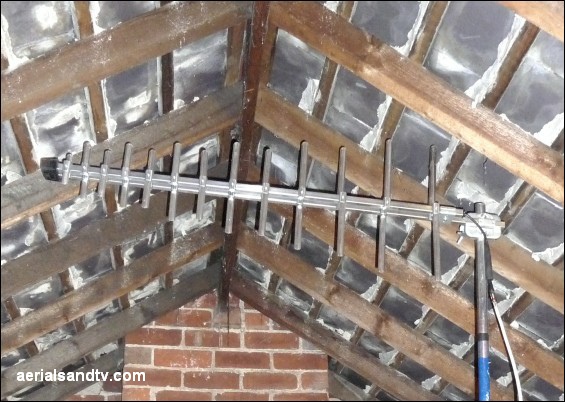
Remember ! There is no such thing as a “Loft Aerial”, there is only an aerial built to go outside which may work OK in a loft if the signal level in your area is sufficient. That said, some aerials are more suitable for loft installations than others....
Furthermore, do not confuse "loft aerials" with indoor / set top aerials.
It is undoubtedly true that aerials work much better without a roof in the way of the transmissions but TV antennas can work reasonably well in lofts provided your signal strength is reasonable or, preferably, good. One should bear in mind that when the transmission power went up considerably at switchover (which occurred 2008 to 2012) many more sites are in decent signal areas than was the case before.
On the other hand, in poor signal areas we do not normally recommend installing loft TV aerials, though some people have no choice as there may be planning restrictions on outside antennas or access problems may be too severe.
Bearing in mind the loss in signal caused by the roof it may be advisable to go for a slightly higher gain antenna than normally recommended for an (outside) aerial in your location.
Remember that if your aerial is mounted outside but pointing back through the roof, or with insufficient clearance over it, then it may actually be preferable to install it in your roof space !
Just as with the cable the attenuation level experienced by the signal (as it passes through the slates) is proportional to the frequency. The higher the frequency the higher the loss.
VHF signals (FM / DAB) will suffer the least attenuation.
UHF (TV) signals will be more affected by the roof.
Satellite frequencies * will result in no usable signal getting through the roof.
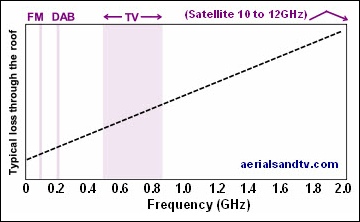
* Remember the frequency received at the dish is about 10x higher than the IF which is sent to the receiver box from the dish.
One interesting point revealed by the above graphic is that the signals at the bottom end of the TV band (i.e. A group frequencies) should suffer less attenuation through the roof than signals at the top end (i.e. [what was] C/D group frequencies) and in fact the same applies to transmission through the air. Some correspondence on the MB21 E Mail list concluded that a signal at 500MHz (=@ CH24) would lose about 4dB less, over 20 miles, than one at 750MHz (=@CH56).
Different roofing materials will attenuate the signal by differing amounts, though as far as I know no one has published any data on this, contact us if you know different ! Generally speaking the losses (at TV frequencies) would be 3 to 10dB which is about 30 to 70% of the signal. During tests inside a (Welsh slate) roof the TV signal was 8dB down on that from an aerial on the chimney, though the latter was installed 9ft higher. However some materials can result in significantly more loss than 8dB, no signal at all will be received through metal sheeting / foil roof linings or solar panels. Some types of roofing material are semi porous and the attenuation level can rise if they get wet, though I have to say there was hardly any difference through the wet/dry Welsh slate roof when I was doing my testing.
When installing an aerial in the loft, try to do it in the autumn or spring ! Being in a loft when the weather is warm can be unpleasant to put it mildly. Personally, for loft work, I’d even say winter would be preferable to a warm summer’s day.
Aerial positioning and alignment
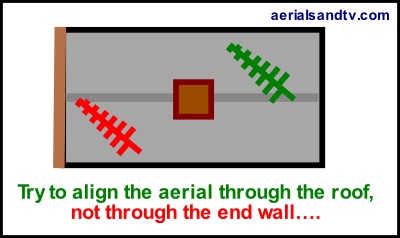
It goes without saying that the aerial alignment should normally be through the slates and not through the end wall(s), and this is particularly important if the house is a terrace and there are even more walls beyond the first ! That said, RF is such a Black Art that it’s always worth trying anything if you’re desperate. Remember we’re dealing with a roof space where RF waves are bouncing around all over the place, anything’s possible !
It is very important to remember that signal levels in lofts can vary significantly between locations within the roof space and the best location can vary even for different models of antenna. Furthermore the signal level can be markedly different for different frequencies (i.e. a particular digital MUX) at different locations ! This variation in signal level can be particularly marked if there are metal objects in the loft, e.g. water tanks. If the latter is in line with the transmitter then it would normally have a very negative effect on the received signal. It is also advisable to try and keep the aerial away from mains cables, at least 3ft, or more if possible. The cable could radiate interference if an unsuppressed load is in use (or an arcing switch) but remember that mains will only usually interfere with TV reception if there is noise on it, see interference tests on cable. On the other hand a solar power inverter did not seem to cause a problem for a customer who had to install an aerial with one.
It’s a good idea to start by placing the aerial in the middle of the loft, and at about 2/3 of the height of the roof space, then work from there. Bear in mind that in order to avoid aligning onto the transmitter through any end wall(s) you may have to place the aerial towards one end of the roof space. If you are struggling for signal then time must be invested in moving the aerial all over the loft, up/down, left/right and forward/backward in order to find the area of highest signal.
If a customer ever has a problem with an aerial from us not working as well as they’d hoped (which, to be fair, is relatively rare) it’s nearly always a loft install *. If we assume that cabling, connectors, wall plates, splitters and/or amps (including excessive signal) have checked out OK then I’d have thought that aerial positioning has to be the cause of most of these mysteries.
* The other recurring theme is when an aerial installer wants to sell them his own aerial.....
One last useful point (sent in by John Allen) once your aerial is aligned it’s a good idea to paint a mark on the inside of the roof showing the direction of the transmitter. Thus, if the aerial is accidentally moved, say whilst retrieving your Christmas tree for its annual excursion, you can easily realign it !
Size does matter, but in this case the shorter the better : most suitable loft aerials
An XB10A is 1ft 2in (36cm) shorter than a Yagi 18A
A DY14WB is 2ft 8in (82cm) shorter than an XB16
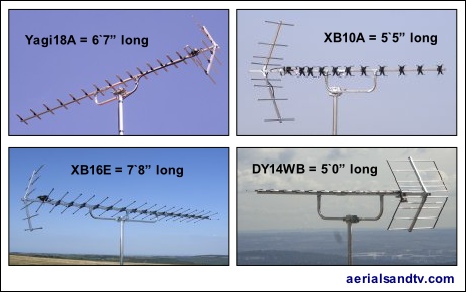
To maximise your chances of being able to locate the aerial at the signal “sweet spot” it may be advisable to go for a slightly smaller aerial. This is a little problematic because there is no such thing as a small “high gain aerial”...... That said, some are smaller than others, e.g. for loft installs in weaker signal areas, despite the fact they perform similarly, we would recommend an XB10A (or B or K) over the equivalent Yagi18A (or B or K. This is because they’re shorter and they can also be end mounted (although if mounting an XB10 outside we’d recommend cradle mounting it). On the other hand, for outside installs we’d normally go for the Yagi over the X Beam, because the Yagis are particularly strongly constructed and have a lower windloading.
For loft installs on wideband transmitters we’d go for a DY14WB because it has good gain for an aerial of that size.
Our loft aerial recommendations are dependent on your signal strength.
In strong signal areas on any transmitter we’d go for a Yagi10K or a Log36.
For strong to medium signal areas on any transmitter we’d recommend a Log36 (or Yagi18K if room for it)
For medium and (especially) weak areas our aerial recommendation would depend on which transmitter you are on, see article “Which Transmitter Am I On”.
For A group transmitters (e.g. Crystal Palace in London) we’d recommend an XB10A.
For B group transmitters (e.g. Sutton Coldfield in Birmingham) we’d go for an XB10B.
For K group transmitters (e.g. Sandy Heath north of London) we’d choose an XB10K.
Remember, trying to receive TV signals from a loft aerial in a poor reception area is never going to be easy, so you can only do your best, possibly utilising a mast head amp, and then hope.......
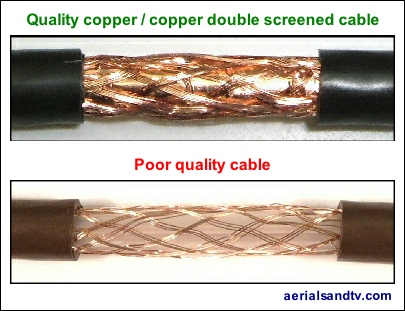
Many aerials in the loft use cable originally installed in the house walls, and the bad news is that this is often crappy “Low Loss Co Ax”. The article on cable explains why cable is so important, particularly for impulse interference with digital signals. The good news is that cable run in wall cavities is less likely to have degraded due to UV exposure and other weather related issues. There is no escaping the fact that it’s best practice to change the cable (particularly if it’s “Low Loss” stuff) but if changing the cable is really difficult I’d try your install with the old stuff first and see how you go.
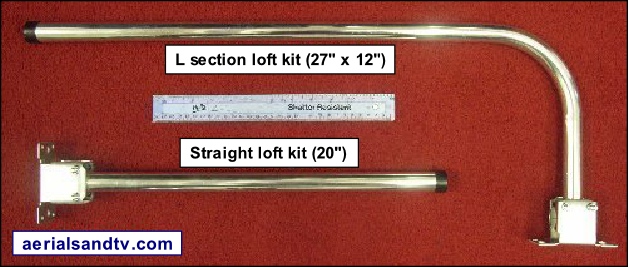
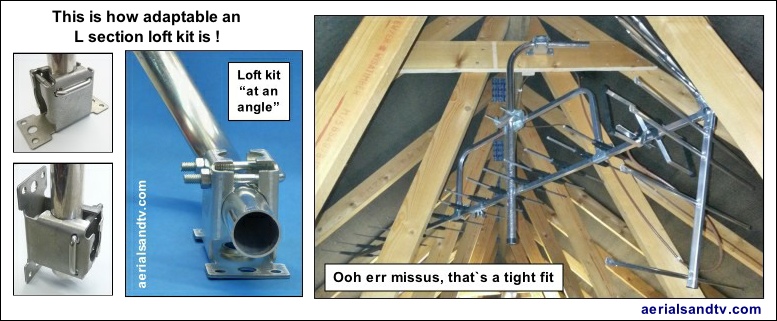
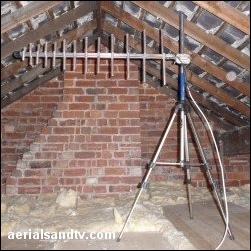
Mounting your loft aerial in a loft by suspending it from the rafters by string (preferably not by wire though ! ) is perfectly fine, but the problem is aligning it whilst using this method is obviously a little problematic, so most people use a loft mounting kit (sold here). I would normally advise using the “L section” kit because it’s very flexible in its use, see the pictures below. Remember you may need to suspend the aerial from the roof truss, but by reversing the “L section” in its bracket (it can also be cut to a straight) you can also use it to mount on a joist. If necessary the pole will also fit into the side of the 2 way surface bracket and then rotated to get an upright pole from a diagonal mounting !
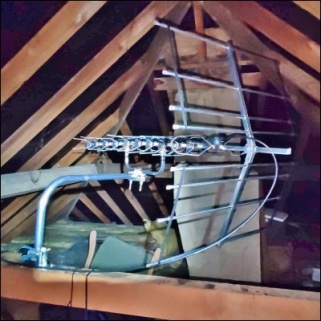
The picture below also illustrates the fact an aerial can be mounted from the top as well as the bottom. Ideally the pole wouldn’t pass through the aerial’s elements, but, because the aerial and pole are opposite polarities, it wouldn’t actually make much difference.
When trying to align your aerial in a loft only use a cheap signal level meter if you’re desperate. The best way is to take a portable TV in the loft with you (make sure it’s tuned to the transmitter you’re trying to pick up ! ) though it must be admitted that aligning a loft aerial was far easier in analogue TV days..... If using the signal level reading on your digital box/TV bear in mind they aren’t always to be relied on but I have found the "signal quality" readings more accurate than those for "signal level". However, at the end of the day what really counts, is how often does your picture freeze or break up, forget any other signal level reading, even from a decent (i.e. £300) meter !
Remember that the maximum signal “sweet spot” for whole TV band may be in one place, but for an individual frequency (i.e. equals one digital MUX) it may be somewhere else !
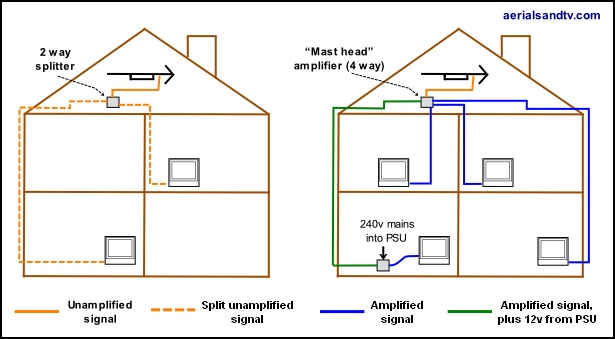
It is still possible to use an amplifier in the loft, if one is needed, even if you have no mains socket by utilising a mast head amp, although in this context the term “mast head” is obviously a misnomer. Amplifiers are not the answer to everything though, particularly post switchover when many more people don’t need amps and a splitter is the way to go. Splitting the signal in the loft using the aforementioned mast head amp (or, in reasonable signal areas, just a splitter) can be very convenient because it makes it easier to feed both sides of the house and/or feed the upstairs rooms straight through the ceiling(s).
Loft Aerial Positioning Tests (Also see this "loft mounted aerial" report)
Just how much difference does aerial positioning in a loft make ?
With the usual caveats about RF tests, I decided to try and put some figures on it.
A similar aerial installed on the roof at this location (which would admittedly be about 9ft higher than the 30” datum) averages about 58dBμV, so installing it in the loft loses about 8dB,which is about 60% of the signal.
The test loft (roofed in Welsh Slate) is in a poor to medium signal area and I must admit I wouldn’t normally recommend fitting an aerial in the loft with a signal level this low unless you have no alternative. Furthermore the location does not have line of site to the transmitter, which from a test point of view makes readings even more erratic. Mind you most loft locations probably don’t have line of site to the transmitter (because the aerial is usually mounted lower than it would be outside) so from that point of view it’s more realistic !
Basically I mounted our usual test aerial (a DM Log Periodic) on a temporarily modified camera tripod and moved it all over the loft taking signal readings as I went. To be frank I ran out of time to do as much as I had originally wanted but on reflection I found out enough as it was.I started off in the middle of the loft space (about 18” above the joist line) and then moved the aerial up one foot at a time. The tripod wouldn’t go any lower than 18” but it was pretty obvious (if anything in RF is obvious, which it isn’t...) that the signal was dropping as the aerial was lowered anyway. The loft isn’t broadside on to the transmitter (Crosspool / Sheffield) which meant aiming the aerial about 45 degrees across to the roof. It also meant that when testing it through the end wall it wasn’t aiming perpendicularly through it.
The figures in blue are for the signal strength (in dBμV) at a point 30in above the roof joists and in the middle of the loft.
The other figures reveal the difference in signal (in dB) at points 18”, 42” and 54” above the joists, i.e. 12” below, 12” above and 24” above the 30” datum.
The aerial was then moved forwards right up to the roof (at the 54” height) and the relative figures for this location are given in the end column.
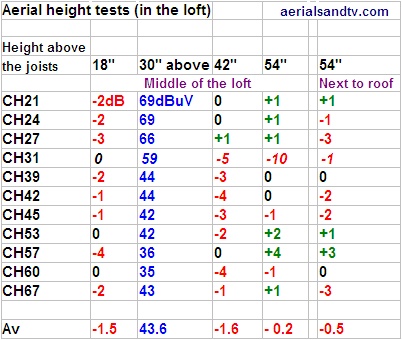
The results table of the main test tells its own story really. The peak reading on average was at 30” above the joists, which was more or less bang slap in the middle of the loft. But the signal level on some of the frequencies was anything but peaked at that height.
Even more significant was the drop off of on some of the channels (CH31 in particular) as the aerial was raised. Two readings were taken on every channel but on CH31 I took four, just to be sure, and it was consistently way down. Let’s just think about this a bit, moving the aerial up one foot knocked 5dB off the signal on CH31 (which was analogue BBC1 off Crosspool / Sheffield). Then moving it up another foot knocked another 5dB off it ! ? ! That’s 10dB in total and that’s a huge amount. To put it into perspective, that’s probably more of a difference than you’d get swapping from a crappy little wideband aerial for an XB16A !
Just to make it more interesting the signal on most of the other channels varied by up 3 or 4dB (up or down according to location) and that’s also a significant amount. It’s the kind of difference in gain between a Log36 and a huge high gain XB22WB ! Similar differences in signal levels were found when the aerial was moved to the sides and front to back, and as an example I moved the aerial as far forwards as possible up to the roof. I’ve read elsewhere that this position can sometimes give maximum signal, all I can say is that it didn’t in this particular case !
Next I deliberately aligned the aerial towards the transmitter through the end wall, which is double thickness brick.
The figures in blue are for the signal strength (in dBμV) at a point in the middle of the loft.
The other figures (in dB) are for the difference in signal at two test points when the aerial was deliberately aimed at the transmitter through the end wall.
The alignment to the transmitter was at an angle of about 45 degrees to the wall. Position 1 was nearer the edge of the wall (at the transmitter end), whereas position 2 was more towards the centre.
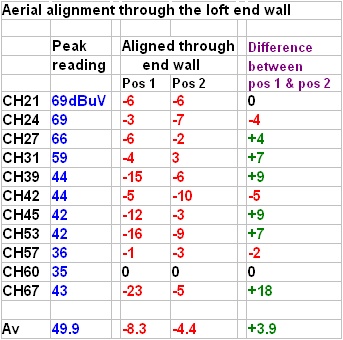
It must be admitted that some of these signal levels are getting so low that the readings were unreliable but it still be seen that aligning the aerial through the end wall knocks the signal down significantly, which is to be expected.
I was surprised, yet again, that there was a 4 dB (average) gain increase by moving the antenna only one foot to the side, particularly as Position 2 was where one would expect the signal to be dropping.
Note the difference in signal can vary significantly according to the frequency / wavelength.
The signal on CH60 was the same at all three positions, i.e. it was the same through the end wall as in the middle of the loft ! On the other hand the end wall reduced CH39 by a whopping 15dB at Position 1 but recovered to “only” minus 6 dB at Position 2, that’s a huge 9 dB difference just by moving the aerial twelve inches ! I know that CH67 (was analogue C5) actually showed an 18dB difference ( ! ) , but the signal level was so low for the readings in Position 1 that it wasn’t really reliable.
Conclusions
Moving an aerial around a loft will generally affect the signal level quite markedly, even more so than outdoors, and the point of maximum signal will vary for different frequencies.
In a strong signal area this may not matter too much, but unless you have the luck to live in one of those then time spent searching out the area of greatest signal may well be a good investment. Aligning the antenna onto the transmitter through the end wall usually attenuates the signal more than aligning it through the roof. Lastly, if getting desperate, do not ignore any possibility as to where the location of maximum signal may be.