

FM and DAB radio aerials
All about FM and DAB aerials and how to get the best signal.
Also see : Basic aerial facts
Subject list :
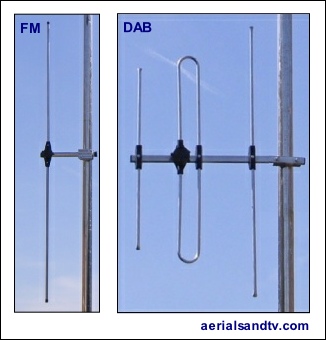
FM v DAB including including :
Basic FM/DAB aerial facts including :
- Radio Bands (MW, LW, FM & DAB)
- External aerial input?
- "Set back" radio aerials
- AM (MW/LW) reception
- Loft mounting FM / DAB aerials
- Picture of the FM & DAB aerials
- Cable considerations
- Signal levels (re splitting FM/DAB)
- The 50Ω / 75Ω mismatch problem…..
- Unexplained DAB/FM interference : MESH WiFi
also see :
- - DAB+ not working on my radio
- - Definition of aerial “gain”
- - Components of an Yagi aerial
- - TV + FM/DAB through your system
- - Diplexing TV with FM and/or DAB
- FM Half Wave dipole
- FM folded dipole
- FM 3 element
- FM 6 element
- FM Omni (not recommended)
- DAB dipole
- DAB 3 element
- DAB 5 element
FM v DAB
Some of the FM buffs who buy aerials from us assure me that FM has a superior sound quality to DAB. Personally speaking I only tend to listen to Radio 4 and Radio 5 so I cannot really confirm this ! But if DAB follows the same pattern as the picture on Digital TV then this rumoured superiority of FM wouldn’t surprise me at all. That said, just like with Freeview TV, this supremacy of the analogue system would only apply if you have a decent signal. Those who have an imperfect signal, and/or a low quality system, would probably find DAB superior. I must say that I have found DAB radios to be less reliable than AM/FM, but there are a couple of things to try with a DAB radio which apparently no longer picks up channels, plus MESH (or 4G/5G) WiFi interference (though this is more likely in any amplifier).
There is one seldom mentioned advantage of the DAB system. I’m told that down in London, and some other big cities, there are so many pirate stations around that getting interference free FM reception can be a little frustrating, but, at the moment, the pirates haven’t cracked DAB. Some cynics reckon that the powers that be are slow timing on prosecuting the pirates to try and force people to switch to DAB !
The story was that in June 2009 the Government published its "Digital Britain" report in which it said it would like to switch off all national analogue radio in 2015, but even then they were only talking national FM transmissions anyway (e.g. BBC Radio 1 to 4 and Classic FM), not local ones, and local included the BBC local radio stations. So don’t go thinking FM broadcasting was ever going to end anytime soon !
There have never been any plans to cease local radio FM transmissions.
The latest twist was in December 2013, the Government abandoned any timetable to switch off analogue radio, which may not come as much of a surprise to some people. Why ? Well, because low band VHF isn’t that suitable for mobile Internet (unlike UHF), so it’s not so worthwhile for the Government who are primarily concerned how much money it’d raise, particularly as the spectrum doesn’t seem to be worth as much these days ! Many people are sceptical about how much the Band II (= FM frequencies) are worth for phones etc anyway. The lower frequency means lower data rates and the aerials would be bigger than the phone ( ! ) plus that band is subject to Sporadic E propagation and high levels of man made electrical interference both of which problematic for digital services.
Here’s an interesting resume of the latest possibilities (updated Jan 2019) on the possible FM switch off.
Probably most significantly, John Whittingdale (in his capacity as government minister for Media, what a soddin' pretentious title.....) stated on the 11th Nov 20 - in an interview on R4's Media Show - that, whilst he wasn't going to put a firm date on the FM switch off, he thought it'd be "at least 10 years". That would make it about 2030 which, possibly not coincidentally, may be about when they might try and turn off Digital terrestrial broadcasting (i.e. Freeview).
July 2020 : apparently FM is safe for at least another 10 years (that'd be 2032 if my maths is correct).
However the fact that radio switchover may possibly happen at some indeterminate time in the future does mean that the FM half wave dipole aerial’s relatively good performance on DAB (and the fact it can be easily cut down to improve DAB still further) is yet another point in its favour!
Basic FM / DAB aerial facts
Historically radio in the UK was always broadcast in three distinct bands, from Long Wave through Medium Wave up to VHF/FM (Very High Frequency), but in 1995 a new digital system was introduced just above the FM band. This was christened Digital Audio Broadcasting, or DAB, and, unlike FM, it is transmitted on a Single Frequency Network. Also, unlike FM, packages of stations are transmitted together (a bit like the Freeview MUXES). These were originally called "Ensembles" but are often now referred to, somewhat confusingly, also as MUXES. In fact it is important not to get DAB confused with the radio channels which are transmitted as part of the Freeview package, that is a different system altogether.
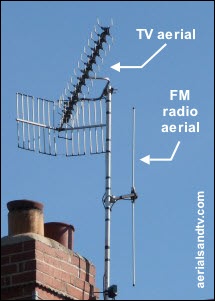
The frequencies of radio bands (and their corresponding wavelengths) are given below :
Long Wave - 148 to 283 kHz = 2020m to 1058m
Medium Wave - 526 to 1606 kHz = 570m to 187m
VHF/FM - 88 to 108 MHz = 3.4m to 2.8m (= Band II)
DAB - 175 to 230 MHz = 1.7m to 1.3m (= Band III)
There is an additional band (Short Wave) between MW and VHF but this has never really been used for public broadcasting in this country.
Notice how as the frequency rises the wavelength falls and the latter then requires shorter element(s) on the aerial in order for it to become resonant. This is clearly illustrated in the picture above and that of the amateur radio aerial array. Whilst it is not relevant for the purposes of this article it should be pointed out that both Long Wave and Medium Wave are Amplitude Modulated (AM) whereas the other two are Frequency Modulated hence the term FM.
Note : since 2017 the BBC have been turning off MW transmitters. TBH I went off the BBC when they turned off Teletext in Jan 2020...
Has your radio got an external aerial socket ? ! ?
Before investing in an aerial for your radio I’d check it’s actually got an external aerial input connection ! Some of the cheaper radios (FM and/or DAB) can only be used with the supplied "set back" aerial because they lack an external aerial input socket. That said, in some cases (particularly for DAB radios) the supplied aerial unscrews and reveals a female F connector socket onto which a lead from a decent aerial can then be screwed. In March 2017 we finally got round to doing some crude tests seeing what improvement in reception (if any) was obtained by connecting an external aerial’s CoAx cable to a telescopic set back aerial on a radio with no external aerial socket. We found that connecting the centre core to the aerial made a significant improvement to reception, both for FM and DAB. Whereabouts along the telescopic aerial the cable was connected (via a crocodile clip) seemed to make little difference. I would say that experimentation in this regard may be worthwhile, you could even try removing the aerial and attaching the external aerial’s CoAx centre straight to the mounting stub. NOTE : it was only the centre core which improved reception, connecting the screening braid made no significant difference at all. Also see this aerial report and this Forum thread on this subject.
When it comes to aerial input connections, most FM tuners have a male CoAx connector socket, i.e. the aerial input lead requires a female Co-Ax on the end of it (which is the opposite of a TV input). Since there are no decent quality female CoAx connectors around (apart from some right angle types) you will require a decent quality male CoAx plug and a Back to Back CoAx coupler to convert it to a female. Alternatively use a right angle CoAx connector are available in either male or female.
DAB tuners invariably have an F Connector socket for the aerial input.
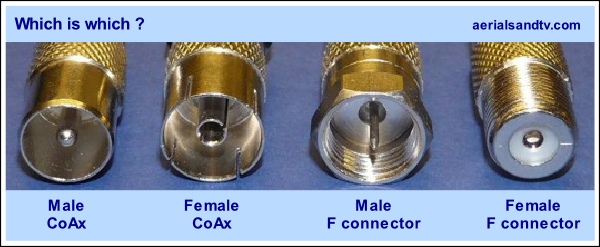
Of the supplied "set back" radio aerials the worst are the single wire types, though as mentioned frequently on this site, signal strength is almost everything. If you live in a strong signal area even a crappy single wire aerial may well work fine ! "T type" wire aerials work better than the single wire types but a decent FM or DAB aerial will usually out perform a "T Type" even if it’s just propped up against the wall by the side of the radio ( ! ) though any aerial will work better in the loft and better still high up outside.
Although I am not an expert in the field of MW/LW (AM) reception I’m told that aerials should consist of a length of wire as long as possible, but remember that the wavelengths are quite large ! Try stringing the wire out in your loft but bear in mind that these bands will suffer interference from the continent during hours of darkness and a more efficient aerial may well just bring in more of this co-channel. Generally speaking a MW aerial is aimed at getting the antenna up away from noise, not just to increase the amplitude of the received signal, see AM aerials (MDS975).
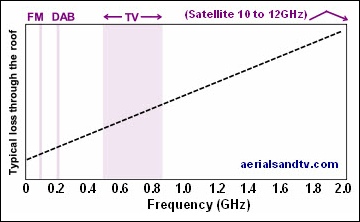
Due to the lower frequencies involved “line of sight” (to the transmitter) is less important than with TV transmission. Similarly installing an aerial in the loft for VHF is not usually so deleterious to the signal as it is for UHF, DAB is somewhere between the two. That said, any aerial will work significantly better without a roof between itself and the transmitter, it’s just that the difference becomes more marked as the frequency rises, higher frequencies (e.g. TV) being much more attenuated than lower frequencies (e.g. FM).
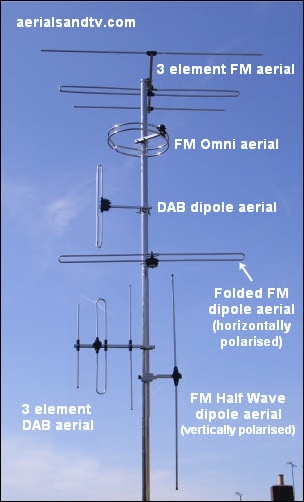
Here are all the commonly available DAB and VHF/FM aerials amounted on one pole. Since this picture was taken we also stock a 6 element FM and a 5 element DAB
The exercise is particularly worthwhile to appreciate the difference in size between the various antennas and the potential for mounting them using different polarities. The FM dipoles we sell (Half Wave FM and Folded FM) will also mount diagonally !
CABLE FOR FM / DAB
This should be 75 Ohm Co-Ax and although the lower frequencies make cable quality less critical than for TV reception it’s still worth using decent stuff ! And we sell it here.
Finally remember that it is possible to diplex FM/DAB signals onto TV downleads or into a TV distribution system.
Signal levels for FM & DAB, plus splitting FM/DAB
Some sources say that for FM you should be aiming for a signal level between 60 and 75dBµV at the tuner input but most tuners will work fine down to 40dBµV (some even lower) and that includes the additional signal [15dB or so] that stereo decoders require.
Arguably a more realistic ideal about 50 to 55dBµV.
For DAB the quoted ideal is 40dBµV to 70dBµV but again many tuners will work perfectly well on less than this, say down to 35dBµV. Aim for 55dBµV ?
Whilst testing FM and DAB aerials on our back wall, not, it should be noted, up on the chimney, we were getting FM figures of 45 to 50dBµVs and DAB at 35 to 40dBµVs and the tuners were working fine. The FM half wave dipole on my roof gives mid/high 50s dBµV on both FM & DAB, interestingly it didn’t give much less in the loft. I also have a little FM/DAB radio in our kitchen which operates off its own poxy little aerial, the FM is probably in the mid 30s dBµV for FM and DAB yet it still works OK, though the FM may not be in stereo, I wouldn’t know because the speakers are only 2” apart. Incidentally, what is the point of having two speakers only 2” apart !
What all this means is that in the real world so long as you’re getting a decent quality signal from a dedicated FM aerial, you can split it quite a few times and, nearly always, it’ll still work fine.
The 50 OHM / 75 OHM impedance mismatch problem…..
Occasionally we get a customer reporting his tuner requires an aerial / cable with 50 Ohm (50Ω) impedance, these are often two screw on terminals. The problem being that 75Ω cable / aerial will result in an impedance mismatch and for maximum signal this is not really desirable. However, I’m not even sure where one could obtain a 75/50Ω matching transformer and even if you could find one the losses in the windings would to a large extent negate its fitting anyway ! The actual loss from the mismatch is likely to be about 1dB (different sources quote different figures, partly because they’re all quoting different frequencies and transmit or receive etc etc) which in most cases is not significant, even less so for FM and DAB as opposed to TV. We’ve still got the problem of connecting a CoAx cable to two posts, personally I don’t see any other way than this one.
(Thanks to Bill Wright for help with this article.)
Unexplained FM/DAB interference : a neighbours MESH WiFi network ?
We have had reports from some customers that their DAB signals etc have suddenly been subject to a lot of interference and they suspected it could be down to a neighbour's MESH WiFi system. Use of a 4G/5G filter (i.e. one like this only accepting VHF and UHF frequencies up to CH48) appeared to solve the problem. This is somewhat unexpected because the frequencies of MESH WiFi are 2.4, 5.0 and 6.0 GHz, which is way over that of VHF (at 47 to 240 MHz) and one would have thought the radios tuner would easily filter them out, but if they are of sufficient level they could cause over load (causing cross modulation) of any amplifier in the system, and possibly even in the radio's tuner.
Bearing in mind said filter is relatively cheap it would suggest that is a good first step on the diagnosis journey !
FM and DAB aerial polarisation
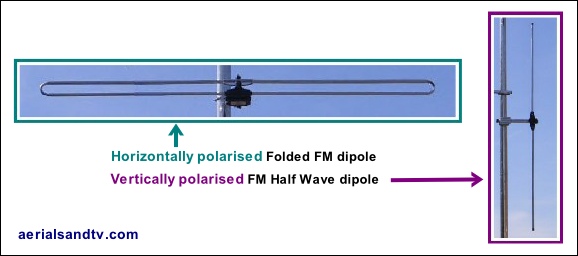
Radio broadcasting is subject to the same polarity criteria as TV transmission, although the Cross Polar Rejection is much less significant than it is for higher frequency television signals.
All DAB transmissions are vertical polarity.
There is an article reprinted (in brown) below which goes into the whys and wherefores of FM polarity and I agree with it generally speaking, consider this section a preamble to it.
As regards BBC FM network all the main transmitters are mixed polarity (for FM, not TV) like Pontop Pike in the picture below. Most of the relay transmitters are vertical polarity like Acklam Wold in the picture below right. This transmitter actually broadcasts BBC Radio York (rather than the BBC National FM stations) but it’s a clear well lit photograph which shows up the transmitting arrays well !
When I last checked, of the 114 BBC National FM transmitters 49 were mixed polarity, this is 43% of the total, but this accounts for far more than 43% of the audience because this figure includes all the high power main transmitters.
Of the others, 63 were vertical polarity, which is 55%.
Only 2 were horizontal polarity, and both of the latter were small transmitters (20W & 30W).
As for the Commercial FM stations a scan of the Ofcom database for all radio stations in the UK revealed only one which is horizontal polarity, all the rest are vertical.
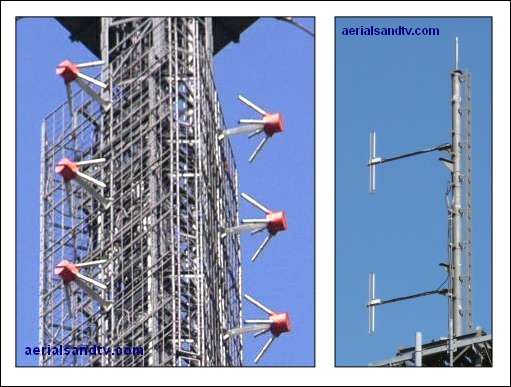
In the picture (left hand image) we have Pontop Pike’s mixed polarity FM transmitting array, this transmits at 134kW.
In the right hand image is Acklam Wold (just south of Malton in Yorkshire) which transmits vertically polarised at 2kW, the two vertical transmitting antennas are clearly discernible.
The following is an extract from and article by Mike at Choice FM which seems to make sense. Make your own mind up !
Polarisation Horizontal or Vertical ?
A topic which still causes lot of confusion when discussing aerials is polarisation whether aerials should be mounted horizontally or vertically.
In the early days (1950s) of FM radio it was found that when the signal was transmitted with horizontal polarisation it seemed to be much less severely affected by vehicle ignition interference. Those were the days when there were very few portable, or in-car, receivers so nobody ever bothered dealing with the problem of ignition interference at source.
However by the 1970s, with transistors having almost completely replaced valves and radios appearing in cars, vehicle manufacturers started paying attention to the problem of engine interference (no point having a car radio if all you can hear is the noise off the spark plugs) and most radio listening was now being done on portable radios with small telescopic aerials which 'pointed up the way' (i.e. vertically).
Suddenly horizontal polarisation didn’t make much sense anymore and broadcasters started reverting to either mixed (horizontal and vertical), or pure vertically polarised signals. Nevertheless, old habits die hard and many aerial installers and even manufacturers still insist that FM aerials should be mounted horizontally, the fact that most (but not all....) TV transmitters [main transmitters that is, not repeaters] use horizontal polarisation probably adds to the confusion. In a very small number of cases (where a station one wants to hear is using mixed polarisation and there is interference from one using vertical polarisation) it makes sense to use a horizontally mounted aerial but, 99% of the time, aerials should be mounted vertically.
I would add here that the above applies for for omni directional aerials,and less so for multi element directional FM antennas.
And don’t forget there's more than one way to change polarity :
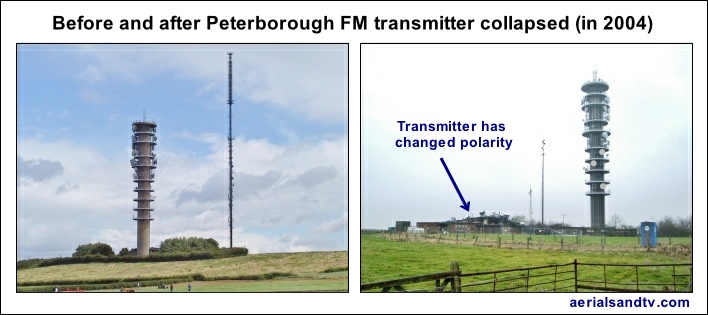
Peterborough transmitter collapsed in 2004 due to a fire.....
Picture copyrights, left Joe Landy/MB21 (before, when vertically polarised), and right, Justin Smith/ATV (after, when horizontally polarised.......). Joke copyright : Andy Burton.
Lastly, one other advantage of a vertically polarised aerial is that perching birds are less likely to be a problem, which is more significant if :
1 - Your aerial is a Half Wave dipole (they’re not as strong as the folded dipole).
2 - Your car is a dark colour and parked underneath said horizontally polarised aerial.
Which direction should I point my FM (or DAB) aerial ?
An interesting question, but also an irrelevant one for most people because the great majority of FM and DAB aerials in use in this country are (theoretically) omni-directional, the most common examples being the excellent FM half wave dipole and its cousin the FM folded dipole. They’re both essentially omni-directional if installed vertically polarised (they’re slightly directional if installed horizontally polarised). The other common omni-directional FM aerial is the Halo type Omni, actually they’re probably more common than dipoles, despite the fact they’re a bit crap…… By far the most common DAB aerial is the DAB dipole, which is the DAB equivalent of the FM folded dipole.
As you would expect from its name an omni-directional aerial theoretically picks up signals from all directions equally. However, when I say theoretically omni-directional I mean it because even if the aerial were truly omni-directional (it’s dubious that any aerial can be 100% omni-directional) it would only be so if it were installed many feet above any roof and mounted on a non conducting pole….. In the real world the amount of signal a theoretically omni-directional aerial picks up would vary, mainly by the influence of nearby roofs but also the effect of the pole on which it’s mounted (particularly if it’s a vertically polarised dipole). Neither of these factors are reliably predictable - though in actual fact hardly anything in the RF game is totally predictable - so my advice is to experiment if that should prove necessary. But it probably won’t prove necessary anyway !
So, having clarified the above, assuming you’ve got a directional multi element FM or DAB aerial, which direction should you point it ? Well that’s not a simple question because not all the stations, particularly the local radio stations, come from the same transmitters, they often do, but not always ! DAB is a bit less affected by this problem so I’d just locate the most likely DAB transmitter (always remembering that “line of sight” is usually a more important criteria than distance) and align your aerial onto it. If that doesn’t work try one of the others ! Bear in mind that DAB is transmitted as groups of between 5 and 12 stations within an ensemble (sometimes just called a MUX these days), this knowledge will help you understand the apparently complicated frequency finder pdf linked to below. Also remember that DAB is transmitted as a single frequency network, i.e. you may be picking up signals from more than one transmitter even for the same station on the same ensemble/MUX.
Thus, more so for FM, the question then becomes which direction do I need to point my aerial in order to pick up what station ? The answer to these questions can be found on the information on the links below.
BBC reception gives a basic prediction for MW, LW, FM, DAB and TV.
NOTE ! Postcode reception predictors are never more than a guesstimate !
DAB frequency finder pdf (which DAB stations are transmitted from which ensembles/MUXES from which transmitters and at what power).
There were a load of links on here to BBC pdfs, but they are all now NLA, thanks Beeb. Still, the remainder of working links are below :
Media Info page listing all the FM transmissions in order
UK commercial radio stations frequency finder DAB and FM
Ofcom’s database of all the MW, FM and DAB transmitters Includes much information, not all of it immediately discernible including the (FM) polarisation in column “O” and “P”, also the radiated power in 10 degree steps (i.e. its radiation pattern).
Ofcom : DAB transmitter locations and coverage predictions
Also see Radiomap.eu (set on Sheffield)
This article does not concern itself with AM radio (MW or LW) because hardly anyone has a directional AM aerial !
The BBC are turning off a load of MW transmitters between May and June 2021, end of an era.....
Identifying the transmitters :
MB21 BBC FM radio transmitter maps
MB21 transmitter gallery
MB21 “all the transmitters” map (may take a while to load ! )
ATV transmitter maps (BBC radio transmitters in blue)
Also see the Digital Spy thread on this subject and frequency finder home page
Top 12 FM transmitters (largest by population coverage)
I managed to get hold of a list of the approximate population coverage for all the FM transmitters, and very interesting it is too, certainly to those of us with mildly autistic tendencies. The population coverage figures are (more or less) for the BBC national stations and are about 20 years old, but I wouldn’t have thought they’d have changed that much. Note that the figures are just for the main transmitter, and don’t include coverage of any repeater(s) off it.
Wrotham (250kW) - - - - - - - - 14.5 million
Holme Moss (250kW) - - - - - 13.6m
Sutton Coldfield (250kW) - - - 7.1m
Black Hill (250kW) - - - - - - - - 3.6m
Wenvoe (250kW) - - - - - - - - - 3.2m
Pontop Pike (134kW) - - - - - - 2.6m
Rowridge (250kW) - - - - - - - - 2.1m
Divis (250kW) - - - - - - - - - - - - 1.3m
Tacolneston (250kW) - - - - - - 1.1m
North Hessary Tor (160kW) - 1.1m
Peterborough (40kW) - - - - - - 1.0m
Oxford (46kW) - - - - - - - - - - - 0.8m
One or Two DAB and FM Inputs on Your Tuner ?
Many tuners come with separate inputs for DAB and FM signals which obviously causes a problem if you’ve only got one combined FM/DAB signal.
What we really need is a “setback” FM + DAB diplexer to split out the FM and DAB signals but I’ve been onto most of the manufacturers but none make one. This leaves you with a number of options :
1 - Use a 2 way splitter. This will obviously only supply half the signal to each input but I’d have thought that most FM/DAB signals would cope with this OK. This method doesn’t split the frequencies into the correct bands for each input but this shouldn’t cause a problem. Splitters are available with either Co Ax or F connectors.
2 - Use a 2 way amp which includes the FM and DAB frequency range, preferably a variable gain model. As with a splitter this method doesn’t split the frequencies into the correct bands for each input but in most cases that wouldn’t cause a problem. Our 3 way mains amp would be suitable for this. Using an amp to split FM and DAB should be a very rare occurrence, I’d only try it if you’ve already tried a splitter (preferably a diplexer or triplexer) and the latter adversely affected the signal.
3 - Use a TV + FM + DAB triplexer, ignoring the TV output if it isn’t required. The one we stock is normally used outdoors but can be removed from its casing to reduce its size. I have to say that from a technical aspect using the FM + DAB outputs from a triplexer is preferable to using a 2 way amp or a splitter, see diplexers v splitters as combiners.
4 - Install separate FM and DAB aerials and run two cables down to the tuner. This is obviously the most hassle (and cost) but theoretically will give the best results. That said utilising the same two aerials and one downlead, but using two* triplexers, wouldn’t be that far behind !
* One on the aerial mast to combine the signals, and one at the set back to split them out.
The reverse situation sometimes applies, i.e. you only have one input on your tuner but two cables, one with DAB on it and one with FM on it. In those circumstances my advice would be the 3rd option (above) but using the triplexer as a combiner (see diplexers v splitters as combiners).