

Digital Freeview TV
Freeview is TV broadcast via transmitters (i.e. terrestrial) to your aerial, for, err, free.
Note, due to the new phenomenon of MUXICAL chairs you may experience problems with certain MUXES disappearing. First try rescanning your TV / set top box, do it manually if possible. If this fails to sort it check on transmitter work or call the reception advice phone numbers.
Also see basic digital fault finding.
Subject list :
Digital Negatives : including :
(compared to analogue)
- Less robust digital signal
- "Digital cliff edge"
- Retune, retune, retune......
- Unreliability of digital TVs/PVRs
- Extra programmes ?
It’s (nearly) all repeats anyway !
Digital Positives including :
Digital Switch Over (DSO) (including how the switchover occurred) For historical interest !
Selling off some of the spectrum
4G/5G transmissions (filtering problems)
- Unexplained TV interference : MESH WiFi network
”Local” MUXES
MUXES 7 & 8 (the "temporary" MUXES : finally switched off in 2022)
700 MHz clearance (in preparation for 5G)
Future of terrestrial TV broadcasting
Freesat (Free To Air Digital Satellite)
High Definition TV (HDTV)
Digital Multiplexes (MUXES) including :
- MUX names and renames
- Programme to MUX allocations
- PSBs (Public Service Broadcasting)
“What is a Digital Aerial” Installation ?
The obvious (and correct ! ) answer is any aerial which receives a Digital signal well enough to allow reliable viewing is a "digital aerial", i.e. there is no such thing as a "digital aerial". Having said that the word reliable, in the opening sentence, cannot be over stressed because if your signal is marginal the Digital Cliff Edge can make viewing Digital a very frustrating experience, particularly when the sound mutes just at the punch line of a joke that’s taken 10 minutes to reach its denouement.......
It must be remembered that before the 2008 to 2012 digital switchover, in order to receive all the digital transmissions from a particular transmitter, a significant number of people may have required a different group of aerial (usually a wideband aerial) and this was where the "term" digital aerial" originated. So, basically, a wideband aerial was mistakenly being called a "digital aerial", though just to muddy the waters still further there was yet more confusion over whether a CAI benchmarked aerial was a "digital aerial" !
Ironically it was (and still is) the case that an upgraded cable or wall plate, or a better quality amplifier or splitter might be just as effective in achieving reliable reception, though with the pre-switchover low power digital transmissions then in use it was more critical. However, even with the low "pre-switchover transmission powers" most people didn't need anything "upgrading" on their aerial installation at all !
Since 2012, when the digital switchover was completed, arguably the term "digital aerial" is (even more certainly) just a marketing term.
Digital Negatives
A Digital TV picture (as in standard definition, not High Definition) is NOT superior to a good analogue picture. In fact (and "the powers that be" are very quiet about this) it’s actually worse. Because the broadcasters want as many programme channels as possible they have sacrificed picture quality (and a really robust signal) to that end. A good (I must stress that word) analogue picture took advantage of its greater bandwidth to give more detail and a "higher refresh rate" to the picture. I accept that one had to look closely at the picture (or be an expert) but a digital picture (not HD) is worse, though some digital channels are worse than others, it’s down to the amount of compression used for that particular transmission. Look at the fine detail (particularly on a moving shot, a football match is a good example) and one can see it "blocking".
The Digital signal is not as robust as the old analogue one. An analogue signal could be really quite poor and one still got a watchable picture. It might have been be grainy, and maybe even ghosting as well, but you can still make out what’s going on and, generally, the sound didn’t drop out…. But a digital signal will not degrade in the same manner. Generally you will either get (what passes for) a perfect picture, or you’ll get very annoying blocking/freezing, or you won’t get anything at all. Sods law being what it is (if you live in a marginal area) this picture loss will occur just when you really, really, don’t want it to.
Digital transmissions have in-built "error correction" (though many people feel there isn’t enough of it...) which can overcome a certain amount of signal degradation. However, once that error correction data has been exhausted the picture has no alternative but to fail spectacularly. This is known as the "Digital Cliff Edge" and it is why one should go for the best aerial, the best cable, screened wall plates (if used), and [if required] a decent screened amp/splitter. Any one of these may (normally) only make a marginal difference, but if they keep your signals on the right side of that "cliff edge", then for what they cost, it’s an excellent investment.
To be perfectly honest you will always get the odd signal “glitch” (freezing etc) with Digital signals and that applies to satellite as well as terrestrial. All you can do is try to limit it as much as possible by maximising the quality of your signal, see graphic.
The graph shows how the relative picture qualities of the analogue and digital systems vary as the signal quality deteriorates.
Note how with a perfect signal the analogue picture is superior to digital (not HD), then falls behind as the signal quality degrades, before retaking the lead when the digital signal runs out of error correction data and falls precipitously down the ”Digital Cliff Edge”.
Note that the quality of the [SD] digital picture can vary according to programme, some (mainly the crappy, “all repeats” esoteric ones.....) are more compressed than others.
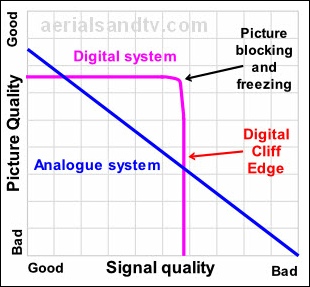
Incidentally (analogue) FM radio and (digital) DAB radio follow the same kind of pattern as the above graphic.
Even in the analogue era, most people had Teletext and that was a also digital system, so was Nicam stereo. Both of these demonstrated the same type of failure mode as digital TV, and also the importance of a decent signal / aerial system because it is deficiencies in reception which were the most likely cause of problems with either Teletext or Nicam.
Teletext is particularly relevant when it comes to error correction data. The header line had significantly more of the latter than had the main body of text. This explained why even when most of the page was a meaningless collection of random letters the header line could still make a reasonable amount of sense. And in the case of Nicam many TVs had the facility to switch it off (and revert to the original FM sound) if the signal level degrades to the point where drop outs are excessively annoying. This was perhaps the ultimate proof of the more robust nature of the analogue signal !
When the Digital Switch Over (DSO) occurred those with Portable TVs running off “set top” aerials tended to be affected in the most negative way. The same situation applied (at some sites) to boaters and caravanners, particularly those using Omni aerials. You do need to be in a pretty strong signal area for a set top aerial, and particularly an Omni, to give you a reliable signal. That said, at the end of the 2009 to 2012 switchover the transmission powers were increased a great deal, so many people are now actually in a strong signal area.
Many people find the setting up/retuning of the Freeview boxes or TVs somewhat complicated, but unfortunately, the days of "tune in once then forget it" have gone because much swapping about of programmes and MUXES will happen over the years, and every time that’s done your box/TV will need retuning. In fact some PVRs also then need all the recordings re-entering.
Why is so much retuning necessary ? See Muxical Chairs…..
In our experience Digital TVs and (particularly) PVRs are not the most reliable * pieces of modern technology and they aren’t easily repairable either. That’s not a big deal if it’s a separate "STB" which has failed (they aren’t that expensive) but if its built into your TV then that’s a rather different story...... It used to be possible to economically repair around 80% of conventional TV’s (i.e analogue, non LCD, non Plasma, non Rear Projection) but with integrated sets it’s far lower than that.
* The most effective way to increase the reliability of any piece of electronics is to keep it cool, i.e. do not place it in an enclosed area on top of Sky boxes or DVD players (or whatever) all producing heat.=
By the way, analogue TV still exists ! Everyone who adds the signal from their Sky box (or CCTV) via a modulator to their distribution system is using analogue TV transmission/reception ! They’re both analogue signals modulated onto UHF frequencies.
Incidentally, different models of STB / TV have differing tuner sensitivities, and it’s not always the expensive ones which are the best either ! We’ve had customers tell us they’ve got significantly more reliable digital pictures by simply changing the STB.
See : Basic digital fault finding.
Let’s be honest, nearly all of the additional programme channels on Freeview (or Freesat, or any other platform come to that…..) are either repeats, or they’re just crap. I know that’s a subjective opinion but I suspect most people would agree with it. Actually, come to think of it, it’s not a subjective opinion at all, most of the programmes are repeats ! (see below). And quality wise there is an inverse proportional law about TV, the more programmes there are, the worse they are. I’ll resist the temptation to give my opinion on producers who try to make their programmes more interesting by using “5 second attention span” editing, one can only assume it’s aimed at kids with attention deficit disorder.
Hold on, I’ve just realised, I haven’t been able to resist the temptation, sod it.
If they continue increasing the number of channels there will eventually come a point where it takes longer to go through the TV guide very week, than actually watch the bleedin’ programmes. Whisper it quietly but there really are far more interesting things to do than watch TV, though these days “Health & Safety Bollocks” seems to try and to put the mockers on most other things......
I tried to avoid getting digital for as long as possible because the wife spent far too long watching TV even when there were only five channels.
Let’s face it, she should be giving me more attention (well perhaps not too much talking).
And doing more housework, obviously.
Remember, a wife isn’t just for doing the cooking,
she’s for doing the cleaning as well.
Only joking girls !
The comments on extra TV channels obviously doesn’t apply if you’re a sports or film fan, but you won’t (generally speaking) get much of either of these on "Free to View" TV.
Quote from the Radio Times :
“ALL PROGRAMMES ON DIGITAL CHANNELS ARE REPEATS UNLESS STATED OTHERWISE”
Nuff said......
Digital Positives
What I said about inferior (standard definition) digital picture quality (over an analogue signal) is undoubtedly true, but that’s only if you had good analogue signals. Unfortunately, many people did not have good analogue signals because they either live in a "fringe" (poor reception) area or they have a poor quality aerial installation. If your signal is of sufficient quality to reliably drive a digital box there are a lot of people who have got a greatly improved picture, digital is particularly effective at eliminating ghosting, provided the signal stays at the top of the "digital cliff edge"
There are more programme channels available and the chances are you’ll like at least one of them. Most TV's / STB’s have basic "interactive" functions on "the red button" which could be really useful, for instance by giving you a choice of which sport at the Olympics you want to watch. Unfortunately at last Olympics the choices seemed to be Synchronised Team Pursuit Fencing or Rhythmic Freestyle Sandcastle Building rather than the swimming that I actually wanted. Consequently I was even more frustrated than I was before ! Let’s give it the benefit of the doubt though, it’s potentially a worthwhile feature. Also digital PVRs (personal video recorders) make recording programmes , particularly a series of programmes far easier. they do have down sides though, like when the PVR breaks down and you lose all your recordings. Few (if any ?) seem to have the ability to copy the content onto another PVR, which is annoying if, say, only the PVR's tuner fails and you don't want to have to keep the old one "in your stack" forever just to access its content !
The reliability of digital transmissions improved considerably at DSO (2008 to 2012) when they turned off the analogue signal. They significantly upped the power outputs of the original 80 digital transmitters, as an example Crystal Palace’s power went up from 20kW to 200kW. Just as significantly they also began transmitting 3 of the 6 MUXES (the most important ones, the so called “PSBs”) from all of the smaller repeaters which had only been transmitting analogue up to that point. The latter are the “fill in” transmitters which are used to increase coverage in fringe areas. Note how they do not broadcast all of the Freeview channels from most of these relays.
Also see Major Transmitters : Which Aerial To Use.
Digital Switchover (DSO) (Left on the site for historical interest)
Digital has actually been transmitted since 1998 when it started as On Digital (remember them ? #1). In 2001 it was rebranded ITV Digital (remember them ? #2), finally becoming Freeview in 2002.
The analogue switch off took place in the UK between 2008 and 2012, and as it was turned off in each area two things happened :
1 - the hundreds of smaller repeater transmitters (which up to that point had only transmitted analogue) swapped over to transmitting [only] digital.
2 - the digital power was substantially increased at the 80 original digital transmitters.
The switchover timings were :
2008 Cumbria & Borders.
2009 SW England, Wales & NW England.
2010 West of England & N Scotland. (Note that Borders was 2008).
2011 Central Scotland, Midlands, Yorkshire & East Anglia.
2012 Ulster, NE England, London, South & SE England.
How the switchover occurred at the 2008/12 DSO
The switch always occurred mid week (usually on a Wednesday) in order to give people time to sort out any aerial work they needed before the weekend. In almost every case analogue BBC2 was switched off first and at the same time the (low power) pre DSO MUX 1 [the main BBC channels] was switched off as well. MUX1 was then reallocated to its post DSO frequency (often that vacated by analogue BBC2) and at its new, much higher, power.
Two weeks later the rest of the analogue channels were switched off and the other MUXES reallocated to their new frequencies at their (higher) post DSO power. There was no technical reason for this phased switchover, in fact it’d have be easier for the broadcast authorities to do it all at the same time. It was to give Joe (or Joanne) Public a chance to sort himself (or herself) out, to get a box if needed or upgrade their aerial, whilst they could still get the other 3 (or 4) analogue channels apart from BBC2 [which will have been switched off].
That said, due to co-channel problems not all transmitters went straight to their final frequencies (or powers) at the second switchover event. Some areas experienced additional switchover events, due to neighbouring transmitters reallocating their frequencies as they switched over. In fact some transmitters also experienced this before their switchover.
At every stage of the process all Freeview digiboxes and TVs needed retuning.
It is easy to forget just how crowded the TV broadcast spectrum was during dual analogue and digital transmissions, this is salutary reminder, compared to this, the situation when the (temporary) MUX 7 was switched off in June 2022.
Incidentally, on the subject of retuning, try not to be a cheeky git, phoning up a retailer for free retune advice if you didn’t actually buy the TV from him ! If he tells you to “sod off !” he’s quite within his rights…… Remember, you really should get your information from where you spend your money, and vice versa. Don’t unfairly exploit harassed TV shop staff (or us) !
Alternatively phone reception advice.
Remember, they’re paid to advise you, unlike the above mentioned chap (or us).
The golden rule is, if having problems with your digital TV, FIRST TRY RETUNING IT !
If possible delete all the existing tuning, then try a full retune.
Retuning help available here and on telephone number 08546 05 11 22
The main reason for all this muxical chairs (requiring retune after retune.....) is because “the powers that be” want to sell off more and more of the UHF broadcast spectrum. First there was the 800MHz clearance (2009 to 2013), then the 700MHz clearance (2017 to 2020), then the MUX8 switch off in 2020. When they do this they have to swap the MUXES all around to avoid co-channel interference (see an example of a channel allocation table) possibly over an extended period.
Anyway the auction for the 800MHz frequencies was held in Feb 2013 and raised £2.3 Billion. Now that might sound a lot but it was actually £1.2 billion less than expected, and let’s not forget that the 3G auction back in 2000 (at the height of the Dot-Com stick market bubble) raised £22.5 Billion.......
The 700MHz band went for a total of £1.3 Billion odd in April 2021, though that was apparently about half what the HM Treasury were hoping for !
So, all this might decrease still further the chance that FM will be switched off ! [link]
However, occasionally, it’s the TV companies themselves who move their MUXES around, partly because some are cheaper to transmit on, the most infamous (for those with kids….) was when “Tiny Pop” moved in March 2017.
Generally when all these transmission changes occur the broadcasters do their best to keep the channels within the original groups of the aerials, though this became almost impossible for the 700MHz clearance, see Winter Hill graph. However, because grouped aerials generally work reasonably well below there designed for band this moving down the band is usually not a problem, unless you’re in a poor signal area.
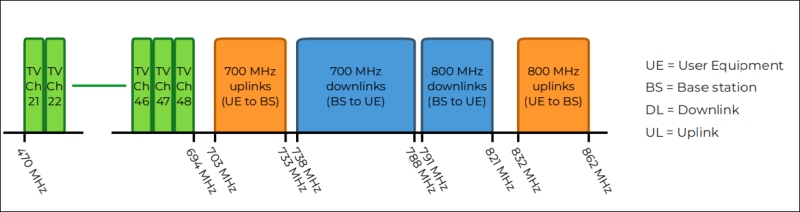
Graphic courtesy of DTG "R Book"
(July 2022)
There is a bit of a problem using the TV band for very high power 4G / 5G transmissions (sometimes called LTE = Long Term Evolution) mobile phone signals, and that is you can cause overload interference in any amps used in TV distribution systems, or even, in extreme cases, in the actual tuners of the TVs or STBs. It is important to note here that interference is most likely to occur in amplifiers (sometimes called “boosters”) and therefore that’s one more reason to try and use a splitter - rather than an amp - in the first place ! Now the standard way of curing this type of problem is to use a filter but you cannot make a filter which will sufficiently attenuate a large signal on CH49, yet let all, or even most of, the signal on CH48 though. Well you can to a certain extent, but it’d be horrendously expensive. To economically achieve the degree of filtering necessary to remove the proposed high power mobile signals would need a gap of between 2 and 4 channels (depending on the losses in the filter). The mobile phone companies are supposed to be paying for the filters but only one per house, so if you’re feeding more than one TV you’ll have to put it on the input to the splitter (or amp). But if it’s an external splitter how are people going to retrofit such filters ? Particularly if they can’t even get to it ! Somebody hasn’t really thought this through have they ? Even if you put a filter on the front end of a system there’s still the problem of all the houses wired up with cheap crappy cable, unscreened wall plates and budget fly leads ! ! !
It’s worth noting that an A group aerials can help filter out the 4G/5G signals very well, but that is only of use on A group transmitters !
Reminder : All amplification increases the chances of mobile interference, so only amplify if you really need to.....
Unexplained TV interference, is it a neighbours MESH WiFi network ?
We have had reports from some customers that their TV signals have suddenly been subject to a lot of interference and this coincided with a neighbour getting a MESH WiFi system. Use of a 4G/5G filter (i.e. one like this only accepting VHF and UHF frequencies up to CH48) appeared to solve the problem though this is somewhat unexpected because the frequencies of MESH WiFi are 2.4, 5.0 and 6.0 GHz, which is way over that of UHF (at 470 to 694 MHz) and one would have thought the TV's tuner would easily filter them out. However, if they are of sufficient level they could cause overload (causing cross modulation) in any amplifier in the system, and possibly, at huge levels, even in the TV's tuner.
Bearing in mind said filter is relatively cheap it is worth trying one to eliminate the MESH possibilities (as well as 4G or 5G).
The “Local” MUXES : initially known as “interleaved spectrum” channels these were originally slated for auction to the highest bidder, but in 2011 the government announced that they could only be used for Local TV programmes, hence the name “Local” MUX. However, the name (“Local”) was already misleading by 2016 because some national programmes are being transmitted on it, most significantly (for parents of small kids ! ) Tiny Pop was moved onto it in March 2017. The list of possible frequencies and radiation patterns for use by local TV channels was on an Ofcom pdf but that seems to have disappeared. Anyway virtually all of them would be receivable on the same aerial group as the other national transmissions.
The “Local” MUXES are due to continue being transmitted after the 700MHz clearance, unlike MUX 7 & 8 whose time is due to run out by 2022. On the other hand Ofcom (as at Apr 2018) “aren’t minded” to re-advertise the remaining 13 (unused) Local TV licences, in fact they’ve admitted there’s been “no expressions of interest” in some of them. So, I wouldn’t hold your breath on an explosion of local TV channels.
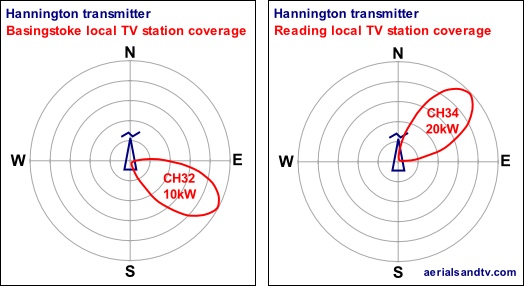
Unfortunately many of these “Local” MUXES are not be transmitted omni directionally and all at lower power due to co-channel issues with adjacent transmitters. The thing to bear in mind is the local stations are just that, local. Unlike the transmitters’ other TV output in most cases the broadcasts are targeted at a particular area. Take the local channels for Reading, the radiation pattern from Hannington is narrowly focused to the north east, whereas all its other output is essentially omnidirectional.
MUX 7 and 8 : the "temporary" MUXES : MUXES 7 & 8 contained mostly rather esoteric HD channels and were broadcast from the 30 transmitters with the largest population coverages. It’s probably fair to say the programmes on them didn’t get the largest audience share.
MUX7 and 8 were originally transmitted in the “CH31-37 gap” (which was created by the post DSO 800MHz clearance) before they were moved up to CH55 & 56 during the 700MHz clearance (2017 to 2020) and from that date they (though only MUX 7 by 2020) were transmitted as a single frequency network.
Transmission of the two MUXES started in late 2013/early 2014 and rom the start it was planned they would cease between 2020 and 2022. MUX 8 was switched off on the 30 Jun 2020, some of its programmes (the most important ones) were transferred to MUX 7 and some (mainly the "plus 1 hour" ones) were switched off permanently. MUX 7 was then on its own and its transmission power was generally lower than for the other 6 MUXES. MUX 7 eventually ceased transmissions on the 30th June 2022. Some stations were moved to the other MUXES, but not, surprisingly, BBC News HD.
700 MHz clearance (in preparation for 5G) - Jul 17 to Aug 20
Back in 2012 Ofcom started a discussion about selling off even more of the TV spectrum, i.e. that from CH49 up to CH60 : “the 700MHz clearance”. By October 2016 Ofcom confirmed that the 700MHz band would be available for 5G mobile data by the second Q 2020. The clearance occurred between Jul 2017 and Aug 2020 (it ended a bit later than originally planned because Winter Hill's clearance was delayed due to Covid).
How much was this section of the spectrum eventually sold for in April 2021 ?
TVs all needed retuning at every change in the transmission frequencies.
This was effectively the death of the C/D group.…
The “new wideband” will be the (existing) K group !
There are some sites on (what were) C/D group transmitters which may well need their aerials changing, particularly if they live in a poor signal area. That said, most people should be OK. The positive side of this move down the band, particularly to the A group, is that if you change your aerial (to the correct group) you’ll get a significant increase in signal.
See before and after the 700MHz clearance : Winter Hill Oughtibridge
Also see changing the groups, past, present and future ?
700MHz clearances links :
- Digital UK
- Ofcom - post 700MHz transmitter CHs “Clearance spreadsheet” (30 Jan 18)
Some transmitters will see little difference after the 700MHz clearance, e.g. Crystal Palace (only the temporary - and now switched off - MUXES 7 & 8 moved), and a few, e.g. The Wrekin, will literally see no change at all. Technically that may the the case, but if other transmitters CHs are moved that could result in co-channel issues etc which may affect reception of a transmitter whose output has not changed.
Future of terrestrial broadcasting ?
How long will TV transmissions continue is a question I’m occasionally asked…. I can only direct you to Ofcom's May 2024 "Report to the government" and in Dec 2022 the BBC said they would go Online only "within a decade". In fact there was a bit of a consensus in the trade that 2030 to 2035 may have see some moves to try and turn off the transmitters, then in Aug 2021 the government extended the MUX licences to 2034. However many think even that even date could really cause some big problems. So who knows ? It is becoming distinctly possible that Terrestrial (i.e. Feeeview) may still be around in 2040 (see broadcast2040plus.org). Some reckon we’ll even need DTT until 2042.
“FreeSat” (Free To Air Digital Satellite)
Freesat is transmitted from the same satellite (Astra 2D 28.2°E) as Sky. This is important because it means that any dish which was installed for Sky should pick up Freesat !
Those who live in an area which can’t get Freeview (terrestrial digital through your aerial) have no choice but to go down the “Freesat” route, that is to say through a satellite dish.
The thing is, are you sure you can’t get Freeview ? We’ve had customers come in to us saying they can’t get it in their area, we look on our installs map (more accurate than the Post Code checker....) and we’ve done digital install jobs on their road, no problem ! Don’t get me wrong, there are sites which will never get a reliable Freeview (terrestrial digital) signal, but, particularly since the 2009 to 2012 digital switchover (with the greatly increased transmission power) there are far fewer.
Freesat is a completely different system from Freeview and the STBs PVRs are not interchangeable.
Points to bear in mind :
More or less all TVs and PVRs they have digital tuner “built in”. For these to work you need a terrestrial digital (i.e. Freeview) signal. Most of those on Freesat still require a separate STB for every set.
Many homes have TV aerial distribution systems fitted so as to get decent signals to all the sets in the house. Since the signal is at UHF frequency it may even work with the kind of budget low specification cable that house builders (and some aerial installers......) put in as standard. Satellite distribution systems (i.e. splitting signals from the dish to a number of STBs, rather than from one STB to a number of TVs) are very much more complicated and expensive. Because the satellite signals are at much higher frequency than the Freeview UHF signal it is unlikely that the type of low quality cabling mentioned above would suffice, so you may even require your house rewiring too. If the cable is run in the walls that is obviously rather problematic to put it mildly.
Heavy rain or snow can degrade the picture ("rain fade"), possibly giving no picture at all for particularly persistent powerful precipitation [I love alliteration]. I was reminded about this during a phone conversation with my brother in New Zealand, and he said they had no (Sky) TV because they were suffering from heavy snow ! The vast majority of people have the standard 43cm mini dish (standard fit from Sky), a larger Zone 2 dish would usually improve matters.
High Definition TV (HDTV)
High Definition TV is about more detail in the picture, and this is great when you’re watching the set from a few feet away, which is precisely the distance you’d see it from in the shop whilst the salesman tries to sell it to you. There is no doubt that HD has a significantly better picture than standard digital one and even a (good) analogue one but for the average size set I have my doubts about how much of the extra detail you would actually see from the normal distance which you would watch TV from. As an example, if you had a 28” TV and sat 10ft (or more) from it then most people would not see any difference in the picture over a (good) analogue 625 line resolution picture. There is no question that High Definition TV would be worthwhile if you had a screen the size of your wall but I’m unsure how many people would actually want a TV of that size. I suppose it would at least save on having to redecorate that side of the room and bearing in mind that these days anyone who doesn’t have a "House Makeover" every other month is considered abnormal (Home Makeovers, the new Rock & Roll ?, count me out....) this could save a considerable amount of time. This saved time could then be used to put in extra hours at work which would then help pay for the expensive wall sized TV you’ve just purchased, and so the circle is closed. Isn’t the symmetry of life beautiful ?
Digital Multiplexes (MUXES) / PSBs
The Digital system (at a loss of some quality and signal reliability......) can broadcast up to 20 programmes per transmission channel. Each one of the latter is called a Multiplex or MUX for short.
The basic programmes found on each MUX are listed below. This information can be used as a diagnostic tool to identify the cause of reception problems. For example if blocking/freezing tends to occur on programmes of the same MUX (but the other MUXs are OK), then the problem is almost certainly a signal or “set up” fault rather than the box, see Digital Cliff Edge. On the other hand if all the MUXES are affected it’s more likely (but not certain ! ) to be a faulty box, or an incorrectly set up system. Also see transmitter overlap / multiple transmitter reception. And don’t forget the Golden Rule, if in doubt try retuning !
Do not discount the obvious ! I can remember when the ITV channels started breaking up on one of our PVRs (digital recorders) but the BBC channels were fine. At the time MUX1 as at much higher power than MUX2, so I put it down to that, until my wife started complaining, so I felt I had to try and sort it out, you know how it is........ I was amazed to find that the lead into the affected PVR had nearly fallen out. It was incredible it worked at all. Still, it was easy to repair the "fault", and the wife was impressed I’d fixed it, so what more can you say !
The next step is to pull everything out (having made sure you draw a diagram of where all the cables go back in, obviously.....) and connect the lead direct from your aerial straight into your STB or digital TV. For the purposes of this diagnostic test it is very important that the signal from the aerial isn’t going through anything else (like a Sky box for instance, or an Amazon Fire Stick, or a Roku stick (or similar)) before being plugged into your TV. Does the fault disappear ? If so find the cause by elimination. Is the fault co-channel from an RF modulator ?
Still faulty ?
Well at least you’ve eliminated a lot !
Incidentally, different models of STB (or indeed digital TV) have differing tuner sensitivities, and it’s not always the expensive ones which are the best either. We’ve had customers tell us they’ve got significantly more reliable digital pictures by simply changing the STB.
If after trying all the above you’re still in doubt as to if the fault is the signal or the box I’d swap round the digiboxes/TVs (or even consider buying a another STB) and trying that by substitution. It’d be cheaper than calling someone out to check your signal !
Use of a “hard reset” (technical name for pulling out the mains plug for a minute or so....) is often successful at “rebooting” a locked up digital TV or STB, and this is especially the case with PVRs/hard disc recorders.
Don’t forget to check your TV (or box) is tuned in correctly, and to the most suitable transmitter. It may be necessary to tune your TV in manually or at least do a “Full Scan”, as opposed to “Add Channels”. Be bold, do not be dissuaded if you get a message warning you will delete existing channels !
Some boxes allow you to delete all channels before you do a scan, and this can be particularly helpful if you’re suffering from the aforementioned transmitter overlap and you want to reorder the channels on your TV.
A few boxes/TVs require you to go into the channel list and manually delete all channels before then doing a rescan, otherwise they just add more channels on, leaving the incorrectly tuned ones also on the list ! If your TV/STB hasn’t got a delete channels function you could try factory reset (though this will delete all your planned recordings….), or you could try pulling out the aerial, then doing a “Full Scan” (to try and delete everything) then replace the aerial and repeat “Full Scan”.
Particularly if you’re doing your first rescan and having problems it may even be the signal strength is too strong and your TV’s tuner is overloaded. In fact you may even need an attenuator, or if you have an amplifier, try removing it (but don’t just turn it off because then you won’t get any signal through it). Note, many TVs/Set Top Boxes indicate no signal (or low signal), even when the actual fault is excessive signal ! We have had this very problem at the shop.
In my view attenuators are a much underrated piece of diagnostic equipment (particularly as they're so cheap), everyone should have one, just in case !
Beware of the powerful 4G/5G broadcasts. These are most likely to affect systems with amplifiers, RF modulated signals (like from a Sky box) and transmissions at the very top of the band.
Finally, some TVs and boxes (particularly PVRs) seem to take time to sort themselves out. I don’t know why. So if you’re only getting one set of channels (i.e. you’re not suffering from transmitter overlap) but the channel numbers are all to cock, try leaving the box for a day or two after your full retune. They sometimes sort themselves out !
Lastly, after you’ve exhausted all alternatives, you could try the extra hard reset.
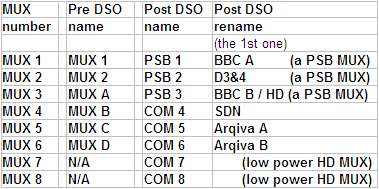
Digital MUX names
The "powers that be" keep changing the name of the MUXES, so we just refer to them as MUXES 1 to 8, as they should be anyway....
Note : MUXES 7 and 8 were only ever meant to be temporary, MUX8 was switched off in Jun 2020, and MUX7 in June 2022
[link]
Also see : MUXES and PSBs
Programme to MUX allocations
(For England, correct as at 1 Jul 22)
MUX 1 / BBC A = Main BBC channels (including the BBC Text & Radio)
MUX 2 / D3 & 4 = Main ITV, C4 and C5 channels + ITV2 / 3 / 4 + More 4 + Film4
MUX 3 / BBC B HD = HDTV channels : BBC1 / 2 / 3 / 4 + CBBC + CBeebies + ITV + C4 + C5
MUX 4 / SDN = CITV + QVC + FIVE USA + Quest + Great Movies Action + Dave ja vu + TalkTV + E4
MUX 5 / Arqiva A = Dave + Sky News + Pick TV + Really + Challenge + Smithsonian + 4seven
MUX 6 / Arqiva B = Yesterday + Ideal World + Pop + GBNews + Great Movies + Al Jazeera
“Local” MUX = Local TV channels + Tiny Pop + Great TV + Great Movies Classic
NOTE : MUX7 was switched off on the 30th June 2022
For a comprehensive up to date list go to Freeview channel listings > England is the 1st column, Wales the 2nd, Scotland the 3rd, and N Ireland the 4th. The order of the columns (e.g. MUX or programme name) can be reordered by clicking on the column header.
Notes.
The first three MUXES are known as PSBs (Public Service Broadcasting) and as such they receive higher priority in the allocation of channel space, or frequencies within a particular transmitter’s original group. Furthermore the PSB’s are often (but not always) broadcast at higher power and/or in a more omni directional pattern than the COMs (= MUXES 4 to 6). The PSBs are the only ones broadcast by the smaller repeater transmitters, remember, these 92 transmitters are the only transmitters to broadcast all 6 MUXES. However, it should be borne in mind the three PSB MUXES contain all the “main” channels (including the main HD channels).
And let’s face it, generally speaking, most of the rest are either repeats, or rubbish.....
Between Nov 2013 and July 2015 things started getting even more complicated when 2 (slightly lower power) HD MUXES were rolled out, but only from the 30 transmitters with the biggest population coverages. However, these were technically "temporary" and indeed MUX8 was switched off in June 2020 and MUX7 in June 2022.
In mid 2016 the ”Local” TV MUXES (more on these here) started to be used for channels other than local TV (e.g. True Crime), thus the MUX name became misleading to put it mildly. This trend became more worrying (to those with young kids….), when, on the 15 March 2017 Tiny Pop moved channels to the “Local” MUX. Suddenly there were parents all over the country phoning us after high gain aerials desperately trying to get this non local programme on the “Local” TV MUX !
NOTE : All Local TV MUXES are broadcast at much reduced power, and most are not transmitted omni-directionally.
So, we now have three levels of service [Approximate population coverage as at 2020] :
7 MUXES (3 PSBs + 3 COMS + 1 "Local") in certain directions from 39 transmitters*…… [50%]
6 MUXES (3 PSBs + 3 COMs) from the 62 next biggest transmitters [90%]
3 MUXES (just the 3 PSBs) from all the smaller repeaters [98.5%]
* Most of those receiving a “Local” MUX will be doing so from one of the main transmitters which also transmit the other 7 MUXES. However, there are some repeaters that just happen to transmit the “Local” MUX (but not MUX7), in those cases it’s possible the viewer would only receive :
7 MUXES (“Local” + 3 PSBs + 3 COMS) e.g. Guildford
or even only 4 MUXES (“Local” + 3 PSBs) e.g. Beecroft Hill in Leeds.