

This site is optimised for a screen resolution of 96 DPI.
Main Page List
ATV Stock Aerial Tests (Also see ATV`s tests of FM / DAB antennas)
This page contains the test results for all the aerials we recommend/stock for the different groups. The results are arranged in tables as follows :
The C/D group aerials we stock
I thought long and hard about how to make the results relevant and comparable with
each other, and have decided to show all readings (in dBμV ) relative to a DM Log Periodic aerial. The latter has a pretty flat gain curve and thus is an ideal control aerial.
Quite apart from anything else, wherever possible (i.e. in reasonable signal areas), Logs
should be used as a matter of course, so the table(s) will show how much gain you have to
make your decision on antenna choice. Note how the Log performs pretty well (in terms of
gain) against small/medium wideband Yagis at the bottom of the band(s) but falls behind
as the frequency rises.
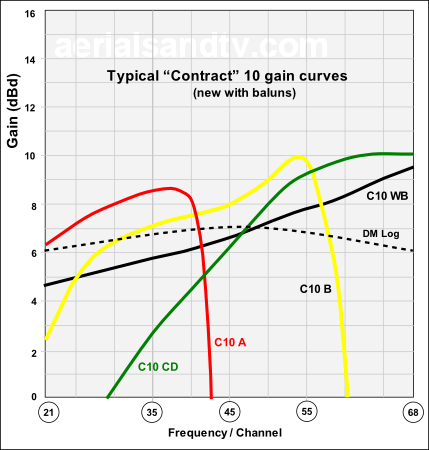
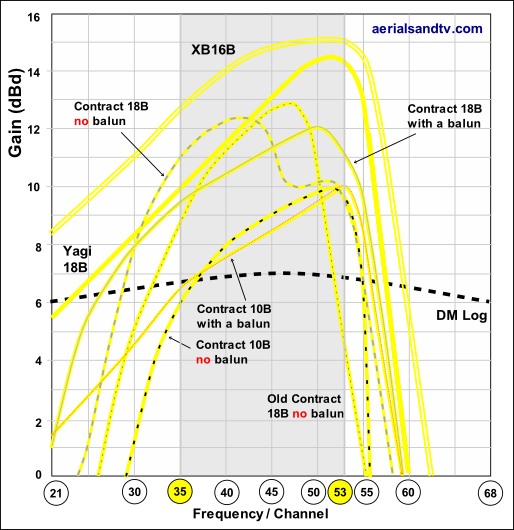
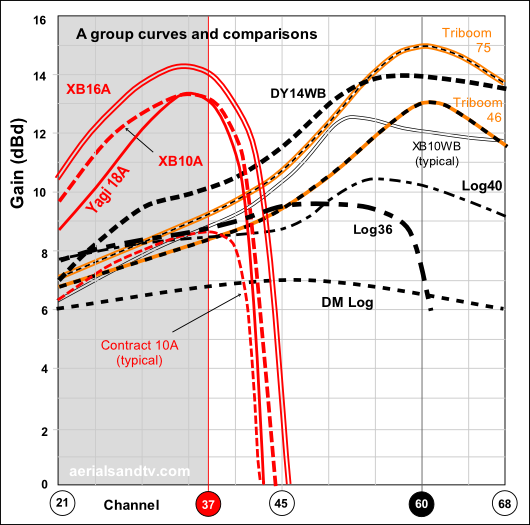
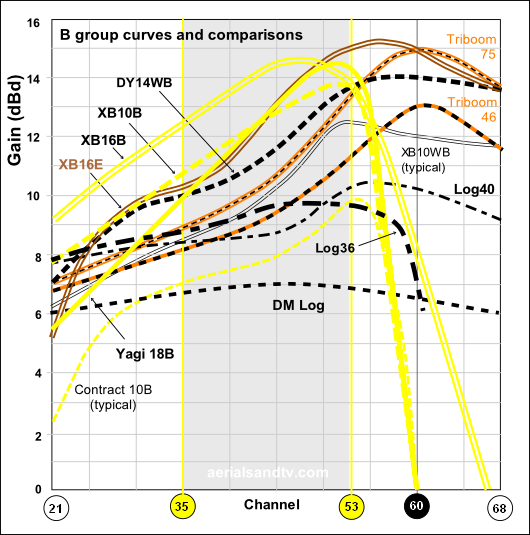
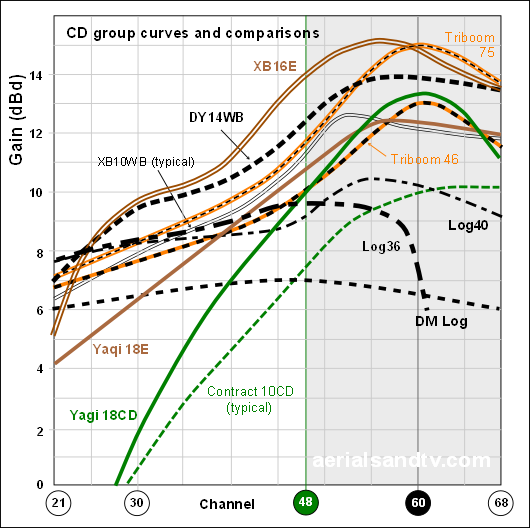
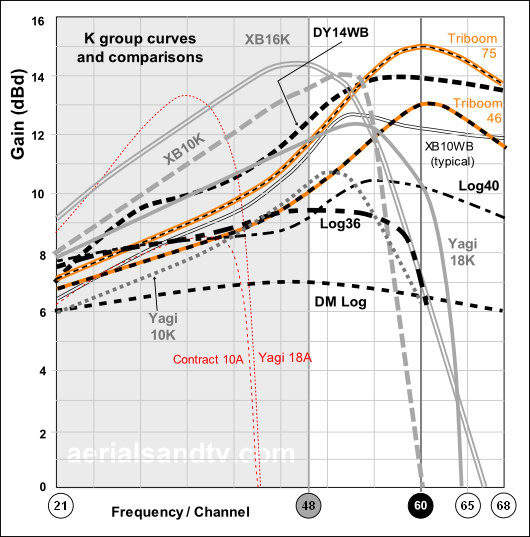
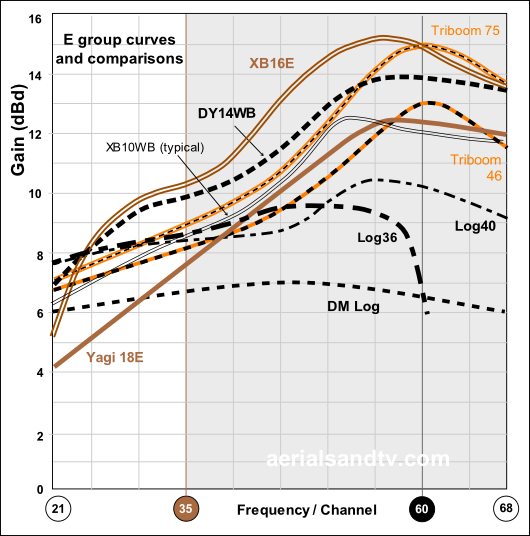
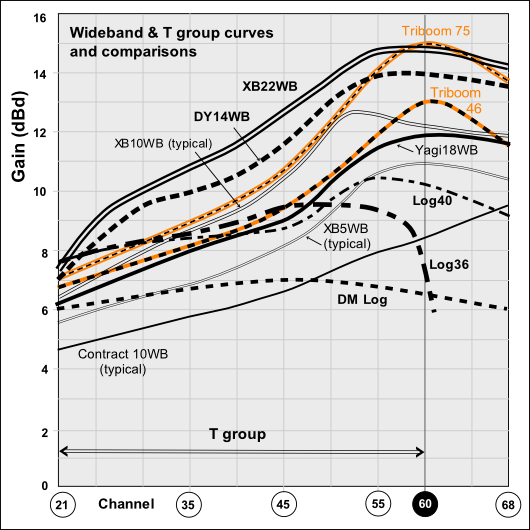
For those who are interested I reckon that the gain of a DM log would be about 6dB at the bottom of the band, then rising by about one dB in the middle, before dropping again at the top end. These are the figures I used when calculating the absolute gain for the graphs.
The absolute gain figures are conservative estimates, but I bet they`re not that far out and one things for sure, they`re all accurate relative to each other !
Note this is dBd, gain compared to a half wave dipole, NOT the (dishonest ? ) dBi....
Differences in the test results of one dBμV on any individual frequency should be disregarded, manufacturing tolerances or a truck going over a hill somewhere between the test site and the TX could easily account for those ! Furthermore the response of any aerial is not linear, it`s gain curve will have bumps and dips in it. That said, a 1dB difference
across the whole band is significant, and an increase (or decrease) of two or three dB is
very significant.
It should be remembered that 3 dB is a 50% higher signal level and such an increase at
the aerial (as opposed to through an amplifier) is very difficult to achieve.
Obviously if you live in a decent reception area these amounts of signal variation are not important, but if that`s the case, you should just use a Log Periodic anyway !
In order to give some idea of the gain of the aerials we also included a Tri Boom Yagi,
e.g. DAT 45, on the tables. We do not stock Tri Booms, but for those who know of them, the figures could be illuminating, over rated.......
I didn`t test the DAT 75 because it was too unwieldy, but Televes report it as being about
the same as a DAT 45 at CH21, rising to +1dB at CH45 and peaking at +2dB by CH62.
Always remember, things aren`t always what they seem.
It should be borne in mind that gain is not everything, which is why Logs are still one
of the best aerials despite being having relatively low gain figures.
Impulse noise rejection, directivity, out of band rejection, cross polar rejection and
front to back ratio and can all have significant effects on the quality of the received signal.
Having said that, gain is a function of the others (apart from impulse noise rejection) as it demonstrates that the antenna is performing efficiently, indeed gain must be a function of the others. Why must ? Well an aerial is a passive device, the only way it can increase its gain (in a particular direction) is at the "expense" of gain in the other directions. As an aerial`s gain increases, its acceptance angle (and its Cross Polar Rejection come to that) decrease. They must do, there is no other way for the aerial to increase its gain.
All of this is before you even start talking about wind loading considerations and/or build quality. Fortunately, we know what we`re talking about when it comes to the latter.
There are no “Bacofoil aerials here.....
the results are explained above.
As expected the A group aerials display the biggest difference in gain over widebands. In fact such is the widebands inferiority
that there is no such thing as a “High Gain” wideband aerial for the A group frequencies.
We recommend the DM log for strong signal areas,
the Log 40 for medium signal areas, the Yagi 18A for poor signal areas and
the XB16A for those with the most marginal signals.
The dimensions of the aerials can be found on
The prices of the antennas are on the Sales page.
In our tests other models
of 18 element A group gave around 3dB (av) over
the A group and I estimate that a DAT 75 would give just under 2dB.
(all relative to the DM log)
the results are explained above.
We recommend the
DM log for strong
signal areas areas,
the Log 40 for medium signal areas, the Yagi 18B for poor signal areas and the XB16B
for those with the most marginal signals.
The dimensions of the aerials
can be found on
In our tests other models
of 18 element B group
gave between 4.2 and 4.6dB (av) over the B group and I estimate that
a DAT 75 would average just under 4dB.
(all relative to the DM log)
the results are explained above.
We recommend the
DM log for strong
the Log 40 for medium signal areas, the Yagi 18CD or the XB10E
for poor signal areas
and the XB16E for
those with the most marginal signals.
The dimensions of the aerials can be found on
The prices of the antennas are on the Sales page.
In our tests other models
of 18 element C/D group gave between 4.1 and 4.8dB (av) over the C/D group and I estimate that
a DAT 75 would average about 6.5dB.
(all relative to the DM log)
We recommend the DM log for strong signal areas,
the Log 40 for medium signal areas, the Yagi 18K for poor
signal areas and the XB16K
for those with the most marginal signals.
The dimensions of the aerials
can be found on
Notice the significant superiority of the K group aerials over the wideband.
In fact such is the wideband inferiority that there is no
such thing as a “High Gain” wideband aerial for the K group frequencies.
I estimate that over the K group a DAT 75 would
average about plus 2.5dB,
relative to the DM log.
the results are explained above.
An E group aerial is a
“semi wideband” whose response is optimised for the middle/top of the
band, at a cost of some gain down at the bottom,
see Group Gain Curves.
We recommend the
DM log for strong signal areas,the Log 40 for medium signal areas,
the Yagi 18E or the XB10E for poor signal areas and the XB16E for those with the most marginal signals.
The dimensions of the aerials can be found on
I estimate that over the E group a DAT 75 would
average just under 6dB, relative to the DM log.
We recommend
the DM log for strong signal areas,
the Log 40 for medium signal areas, the XB10WB for poor signal areas and the XB22WB for those with the most marginal signals.
The dimensions of the aerials can be found on
The prices of the antennas are on the Sales page.
Other models of 18 element wideband
which we tested averaged between
1.7 and 2.6dB over
the whole band.
I estimate that over the whole band a DAT 75 would average just
over 4.5dB, varying from just under 2dB in the A group up to around 6.5dB in the C/D (all relative to the DM log).
Note, there is no wideband aerial which will give “high gain” at the bottom of the band.
If you must have a wideband, and you require more gain at the bottom end, you`re best option is to diplex an A group with an E group, or even an A group with another (high gain) wideband if you already have one of these.
Remember that most people don`t need a “high gain” aerial though !
The above table is a summary of the A group results,
B Group Aerials
The above table is a summary of the B group results,
C/D Group Aerials
The above table is a summary of the C/D group results,
K Group Aerials
The above table is a summary of the K group results,


E Group Aerials
The above table is a summary of the E group results,
Wideband Aerials
The above table is a summary of the wideband group results,


A Group Aerials